Introduction.
Viruses are microscopic infectious agents that are smaller than bacteria and can only reproduce inside the living cells of other organisms. They are acellular, meaning they are not made of cells, and consist mainly of genetic material (DNA or RNA) enclosed within a protein coat called a capsid, and in some cases, a lipid envelope. Viruses are unique because they show both living and non-living characteristics—outside a host they are inert, but once inside, they hijack the host’s cellular machinery to multiply. They infect all forms of life, including animals, plants, bacteria, and even fungi, and are responsible for many diseases such as influenza, HIV/AIDS, and COVID-19.
Structure of Viruses.
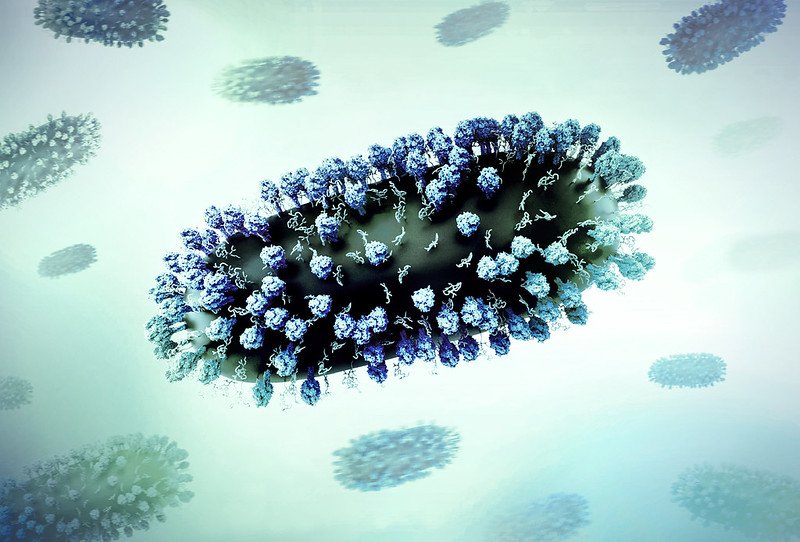
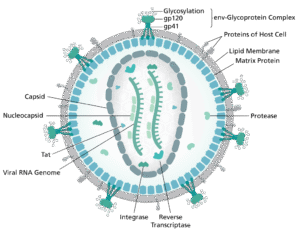
Viruses are acellular infectious agents because they are not composed of entire cells and have simple structural components as opposed to complex structure. The basic structure of a virus is distinct and consists of nucleic acid, which can either be DNA or RNA, which is the genetic material needed for viral replication. The nucleic acid is surrounded by a protein-coated capsid, made of subunits called capsomeres, which protect the nucleic acid and assist the virus in formulation to attach to a host cell. A virus can have an outer lipid envelope taken from the host cell(s), consisting of glycoprotein spikes that are used for recognition and entry into host cells. A virus has no organelles of the host cells such as ribosomes and cytoplasm; therefore, a virus does not replicate without a host cell. There is a wide range in size and shape of viruses; they can consist of helical, icosahedral, and/or complex shapes (bacteriophage infect bacteria).
Genetic Material
- Either DNA or RNA, but never both.
- Carries instructions for making new viruses.
Protein Coat (Capsid)
- Surrounds the genetic material.
- Made of protein subunits called capsomeres.
- Protects the viral genome.
Envelope (in some viruses)
- A lipid membrane surrounds the capsid.
- Derived from the host cell’s membrane.
- Has proteins (spikes) for attaching to host cells.
- Example: Influenza, HIV.
Enzymes (in some viruses)
- Special enzymes like reverse transcriptase (in HIV).
Characteristics of Viruses.
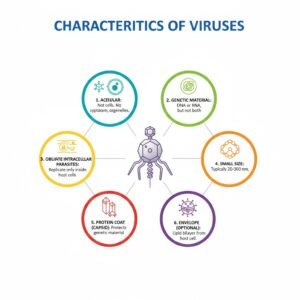
Acellular Structure
- Viruses are not made of cells. They consider between living and non-living.
- They consist of genetic material (DNA or RNA) surrounded by a protein coat (capsid), and sometimes an envelope.
Obligate Intracellular Parasites
- Viruses cannot live or reproduce on their own.
- They must infect a living host cell to multiply.
Genetic Material
- Contain either DNA or RNA, never both.
- Genetic material may be single-stranded or double-stranded.
No Metabolism
- Viruses lack enzymes for respiration or energy production.
- They rely completely on the host cell’s machinery.
Size
- Extremely small, ranging from 20 to 300 nanometers, much smaller than bacteria.
Reproduction
- They reproduce by directing the host cell to make new viral components (not by cell division).
Host Specificity
- Viruses infect only specific hosts (e.g., bacteriophages infect bacteria, HIV infects human T-cells).
Living & Non-Living Nature
- Non-living outside the host: inert particles.
- Living inside a host, it can replicate and evolve.
Pathogenicity
- Many viruses cause diseases in plants, animals, and humans (e.g., measles, polio, COVID-19).
Types of Viruses.
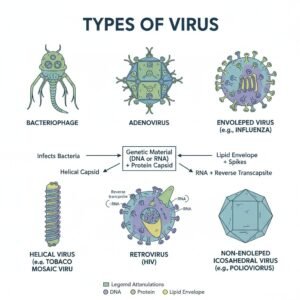
1. Based on Shape / Structure
- Helical Viruses – They are Rod-shaped, with genetic material inside a spiral capsid.
Example: Tobacco Mosaic Virus (TMV). - Icosahedral Viruses –They are Spherical with a 20-sided capsid.
Example: Adenovirus, Poliovirus. - Complex Viruses – Their structure is complicated, often with tail fibers.
Example: Bacteriophage (a virus that infects bacteria). - Enveloped Viruses –They are surrounded by a lipid envelope with spikes.
Example: HIV, Influenza, Coronavirus.
2. Based on Type of Genetic Material
- DNA Viruses – They contain DNA as genetic material.
Examples: Herpesvirus, Adenovirus, Poxvirus. - RNA Viruses – They contain RNA as genetic material.
Examples: Influenza virus, Rabies virus, Coronavirus. - Retroviruses –They are Special RNA viruses that use reverse transcriptase to make DNA inside host cells.
Example: HIV Virus.
3. Based on Host Organism
- Bacteriophages –They infect bacteria.
Example: T4 phage. - Plant Viruses – They Infect plants.
Example: Tobacco Mosaic Virus. - Animal Viruses –They infect animals and humans.
Examples: Rabies virus, Influenza virus, SARS-CoV-2.
Importance of Viruses.
Viruses are well known for causing disease; however, viruses are also a very important aspect of our natural world, as well as in medicine and biotechnology. For example, viruses are one thing that can help to control bacteria, algae, and all other organisms that are present in our ecosystems. When too many organisms are in a food chain or nutrient cycle, viruses can help regain balance since viruses can decimate bacteria, algae, or any other organism. In medicine, viruses are used as vaccines against very serious diseases, like polio, measles, and influenza
Beneficial Roles:
1. Medical Research & Biotechnology
- Viruses are used as vectors to deliver genes in gene therapy.
- Help in developing vaccines and studying genetics.
2. Vaccine Production
- Some viruses are weakened (attenuated) or inactivated to create vaccines, e.g., polio, measles vaccines.
3. Bacteriophages in Medicine
- Phages are used to kill harmful bacteria (phage therapy), especially in antibiotic-resistant infections.
4. Molecular Biology Studies
- Viruses helped scientists understand DNA, RNA, and protein synthesis.
- Example: Bacteriophage studies led to the discovery that DNA is the genetic material.
5. Agriculture & Ecology
- Certain viruses control pest populations in crops.
- Maintain ecological balance by regulating host populations.
Harmful Roles:
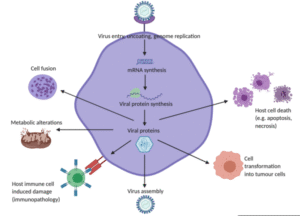
Viruses are harmful because they must invade living cells in order to reproduce and make copies of themselves. It often damages or destroys the cells of the organism (the host) as a part of that process. Other viruses may induce long-term or chronic health problems (gastrointestinal symptoms, for example) that disrupt normal body functioning. Viruses, like bacteria, are not “killable” with antibiotics, rendering their treatment usually to vaccines, antiviral medications, or supportive care. This is the picture of the major harm + risk, where viruses cause major harm. Viruses majorly affect human health and animals, plants, and entire ecosystems.
Human Diseases
- Cause diseases like influenza, HIV/AIDS, COVID-19, hepatitis, measles, rabies, and polio.
Animal Diseases
- Affect livestock and pets, e.g., Foot-and-mouth disease, Rabies.
Plant Diseases
- Damage crops like tobacco, potatoes, and tomatoes (e.g., Tobacco Mosaic Virus), leading to economic loss.
Pandemics
- Viruses like coronavirus (COVID-19) cause global health crises.