What is the Mutation?
A mutation is a change in the DNA sequence of an organism’s genetic material. It can occur in a single nucleotide (the basic unit of DNA) or affect large sections of DNA, including entire genes or chromosomes. Mutations alter the genetic code. They can happen naturally or be induced by environmental factors. Some mutations have no effect; they benefit the organism, while others may be harmful or beneficial. During DNA replication (copying of DNA before cell division). Due to errors in cell processes. From exposure to mutagens (like radiation or chemicals). They are the source of genetic variation. Some cause diseases, others drive evolution. They can be silent (no effect), harmful, or beneficial. They are detected by DNA sequencing, PCR, and gel electrophoresis. They also check with Genetic testing (e.g., for inherited diseases). Karyotyping (for chromosomal abnormalities).
Types of the Mutation.
1. Based on Scale
A. Gene (Point) Mutations – affect a single gene or nucleotide
-
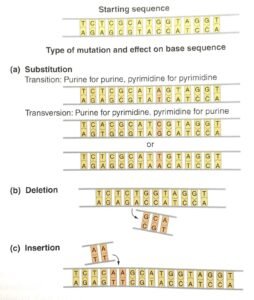
Substitution: This is the type of point mutation. DNA has 4 types of base pairs. In which one base is replaced by another base. A small change can lead to a major effect. → e.g., A → G
-
Insertion: Insertion mutations are point mutations that add one or more nucleotide bases to the DNA sequence. The addition of this genetic material may change how the genetic code is read during protein synthesis. Insertion of nucleotide bases will cause a frameshift mutation if the added bases do not add up to a multiple of three, subsequently changing the entire reading frame of the gene. Inserting extra nucleotides alters the reading of all the codons after the mutated base in the sequence, leading to a less recognizable protein structure, potentially leading to a non-functioning protein with no support to the gene. add Extra nucleotide(s) added
-
Deletion: Unwanted Nucleotide(s) removed. If the number of deleted bases is not a multiple of three, then a change in the reading frame will occur, and every codon that follows will be altered. This often results in a completely different and nonfunctional protein. If only three nucleotides (or multiples of three) are deleted, only one or more amino acids will be lost, and the change may not have as serious an effect. Deletion mutations can cause serious genetic disorders, depending on the size and position of the deletion from the gene.
B. Frameshift Mutations
-
Caused by insertions or deletions that shift the reading frame
-
Alters every amino acid after the mutation
2. Based on Chromosome Structure
A. Duplication
- A small part of the DNA is copied more than once.
B. Deletion
- A segment of a chromosome is lost
C. Inversion
- A chromosome segment breaks off, flips, and reattaches
D. Translocation
- A small piece of one chromosome attaches to another chromosome.
Cause of the Mutation.
Mutations can be caused by internal (spontaneous) factors or external (induced) agents. These changes affect the DNA sequence and can lead to genetic variation or disorders.
1. Spontaneous Causes (Natural/Random).
These occur without any outside influence, usually due to normal biological processes.
- DNA Replication Errors: Mistakes made during the copying of DNA (e.g., inserting the wrong base).
- Spontaneous Base Changes: Some bases can chemically change (e.g., cytosine can deaminate to uracil).
- Tautomeric Shifts: Rare base forms cause incorrect base pairing during replication.
- Transposons (“Jumping Genes”): Mobile genetic elements that insert themselves into different DNA sites.
- Reactive Oxygen Species (ROS): By-products of metabolism that can damage DNA bases or the backbone.
2. Induced Causes (Environmental Factors).
Radiation:
- UV light (sunlight): Causes thymine dimers – leads to DNA distortion.
- X-rays, gamma rays: Break DNA strands or cause large-scale chromosomal changes
Chemical:
- Base analogs (e.g., 5-bromouracil): Substitute for normal bases, causing mispairing
- Alkylating agents: Modify bases, making them pair incorrectly
- Intercalating agents (e.g., ethidium bromide): Insert between bases, causing frameshifts
Biological:
- Viruses (e.g., HPV): Insert their genetic material into host DNA
- Bacterial toxins: May cause DNA damage or affect repair mechanisms
Effects of Mutation.
1. Types of Effects
A. Neutral (Silent) Mutations
- No observable effect on the organism.
- Usually occurs in non-coding DNA or when a codon change doesn’t alter the amino acid (due to redundancy in the genetic code).
Example:
AAA (Lysine) → AAG (also Lysine) → No change in protein.
B. Beneficial Mutations
- Provide a survival or reproductive advantage.
- Rare but important in evolution.
Example:
- Lactose tolerance in adults
- Sickle cell trait provides resistance to malaria
C. Harmful (Deleterious) Mutations
- Negatively affect protein function, cell processes, or overall health.
- It can cause genetic disorders, like birth defects and cancer.
Examples:
- Sickle cell anemia: Missense mutation in the hemoglobin gene
- Cystic fibrosis: Deletion of 3 bases (ΔF508)
- Cancer: Mutations in tumor suppressor genes (e.g., TP53)
2. Effects at the Protein Level
- Silent: No change.
- Missense: One amino acid change may alter protein function.
- Nonsense: Protein becomes too short, usually nonfunctional.
- Frameshift: Alters many amino acids — often completely disrupts the protein.
3. Effects on the Organism
- Cellular: Protein malfunction, cell death, or uncontrolled growth (cancer).
- Tissue/Organ: Impaired function (e.g., lung damage in cystic fibrosis).
- Whole organism: Disease, birth defects, altered traits.
- Population: Genetic diversity (can be positive or negative)