Introduction.
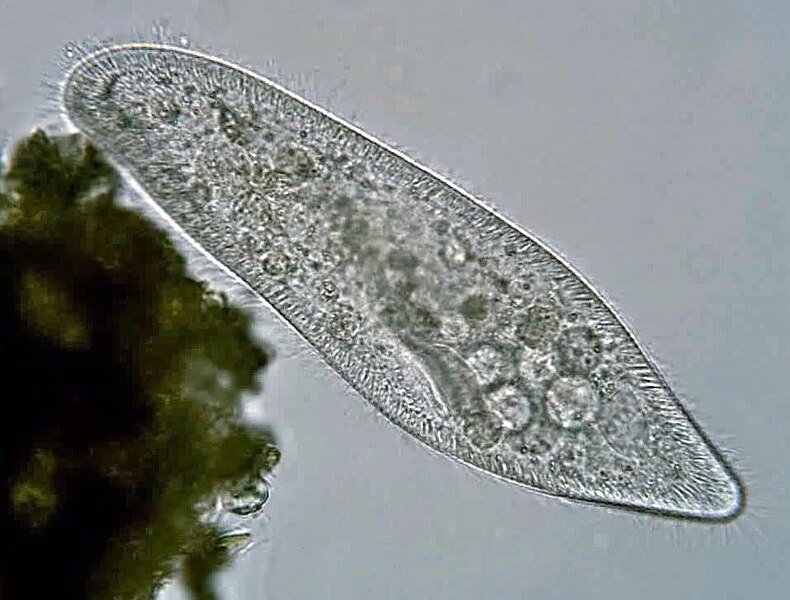
Paramecium is a single-celled, microscopic organism that belongs to the kingdom Protista and is commonly found in freshwater environments such as ponds, lakes, and streams. It is often called the “slipper animalcule” because of its elongated, slipper-like shape. The entire body of Paramecium is covered with tiny hair-like structures called cilia, which help it move and direct food into its oral groove. Inside the cell, it has specialized structures such as food vacuoles for digestion, contractile vacuoles for regulating water, and two nuclei: a macronucleus for daily functions and a micronucleus for reproduction. Paramecium feeds on bacteria and small microorganisms and usually reproduces by binary fission, though it can also exchange genetic material through conjugation. Because of its unique structure and simple organization, Paramecium is widely studied in biology as a model organism.
Structure of Paramecium.
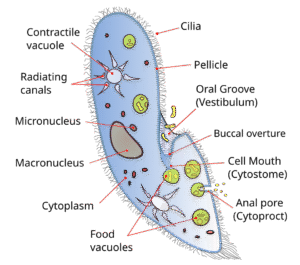
- Cell membrane (Pellicle): Flexible outer covering that gives shape.
- Cilia: Tiny hair-like structures covering the body, used for movement and to sweep food into the mouth.
- Oral groove: A depression leading to the cell mouth (cytostome) for food intake.
- Food vacuole: Stores and digests food particles.
- Contractile vacuole: Removes excess water (osmoregulation).
- Nucleus: Has two types:
- Macronucleus – controls day-to-day functions.
- Micronucleus – involved in reproduction.
Characteristics of Paramecium.
- Unicellular: Paramecium is a single-celled organism, and it belongs to the kingdom Protista.
- Shape: Paramecia have a Slipper-like or cigar-shaped body, and they are called the slipper animalcule.
- Body covering: the paramecium’s body is surrounded by a flexible pellicle that gives it a definite shape.
- Symmetry: Paramecium shows bilateral symmetry body plane (two equal halves).
- Nutrition: Paramecia are Holozoic and feed on bacteria, algae, and small protozoans through an oral groove.
- Respiration: Paramecium exchanges gases (O₂ & CO₂) by simple diffusion through the body surface.
- Excretion & Osmoregulation: Uses contractile vacuoles to remove excess water and maintain balance.
- Movement: They move by ciliary action (coordinated beating of cilia).
- Reproduction:
- Asexual – by binary fission.
- Sexual – by conjugation (exchange of genetic material).
- Sensitive to environmental changes and light.
Types of Paramecium.
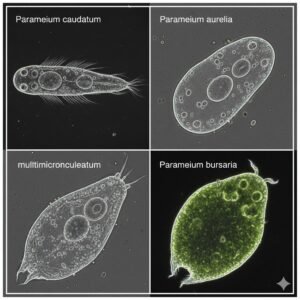
1. Paramecium caudatum
- The most commonly studied species.
- They are Large in size (up to 300 micrometers).
- They are found in freshwater ponds.
- Has a long, pointed caudal (tail-like) end.
2. Paramecium aurelia
- They are Smaller and more rounded than P. caudatum.
- They are often found in dense populations.
- Known for showing conjugation frequently (sexual reproduction).
3. Paramecium bursaria
- Lives in symbiosis with green algae (Zoochlorella) inside its cytoplasm.
- The algae provide food (through photosynthesis), while the Paramecium offers protection.
- Appears green in color because of the algae.
4. Paramecium trichium
- Medium-sized species.
- Less commonly studied compared to P. caudatum and P. aurelia.
5. Paramecium multimicronucleatum
- Paramecium are larger species that can grow up to 350–400 micrometers.
- They are characterized by having multiple micronuclei (hence the name).
Importance of Paramecium.
- Paramecium helps control the bacteria population in water.
- Paramecium is a Food source for small aquatic animals.
- Paramecia are Model organisms used in labs for studying cell functions.
- They act as decomposers by feeding on bacteria and small microorganisms, thus controlling their population.
- They helps in research on protozoan genetics and cellular physiology.
- Its symbiotic relationship with algae (P. bursaria) is important for research in ecology and mutualism.
- They demonstrate important biological processes like ciliary movement, binary fission, and conjugation.
- It is Sensitive to changes in water quality, so it can be used as a bio-indicator of pollution levels.
Reproduction of Paramecium.
Paramecium reproduce by two main types Asexually and Sexually.
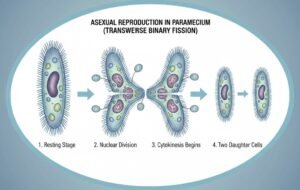
Asexual reproduction (Binary Fission)
Asexual reproduction by binary fission is the most common method of reproduction in Paramecium. The process entails the division of the cell into two identical daughter cells. The division of the macronucleus is amitotic, while the micronucleus divides normally by mitosis, followed by the splitting of the cytoplasm or cytokinesis that will produce two complete organisms. This process is quite fast, and Paramecium can proliferate quickly under optimal conditions.
Sexual Reproduction (Conjugation)
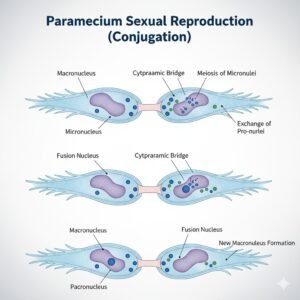
Paramecium reproduces sexually (involves swapping nuclear material) when conditions become unfavorable (such as the population becoming too dense). In conjugation, two Paramecia join together, exchanging haploid nucleic material in the form of a micronuclei, while establishing a cytoplasmic bridge. Each cell undergoes meiosis, exchanging nuclei. The transferred nuclei will fuse with the nuclei from inside the cell (sometimes referred to as micronuclei). The resulting results are two cells that have gone through genetic recombination that can generate a new diploid nucleus. After conjugation, the two paired cells separate and undergo binary fission, whereby they are capable of genetic variation, which increases their chance of adaptation.
It is another method for the reproduction of Paramecium
Autogamy (Self-Fertilization)
In the process of autogamy, a micronucleus in a single Paramecium goes through meiosis and two glued haploid nuclei then fuse within the same cell to restore vigor to the organism’s genome. No genetic exchange takes place, because it is still self-fertilization, which permit Paramecium to persist in the absence of partners suitable for conjugation.