Pancreas
The pancreas is one of those organs that we don’t often think about, yet it plays a role in almost everything we eat or use in our bodies. It runs silently behind the stomach, just above the stomach, and is about the size of a hand. Although it doesn’t get as much attention as a pulse or a pulse, life is possible without it. What makes the gut special is that it does two completely different jobs at the same time. On the one hand, it helps us digest food.
Health problems can quickly become serious, from obesity to diabetes, from inflammation to even cancer, which can lead to heart disease. ya samjna kah ya chhota lican tqtor azo kas tarah kam karta hai is bat ko samjne min hamari madad karta hai ka ya hamari romarah ki zandgi ke liye ktana zarori hai.
Role of Pancreas in Digestion
- It is the most important digestive gland of the system. Its enzymes digest almost all food
groups. - It is located below the stomach & encircled by the duodenum.
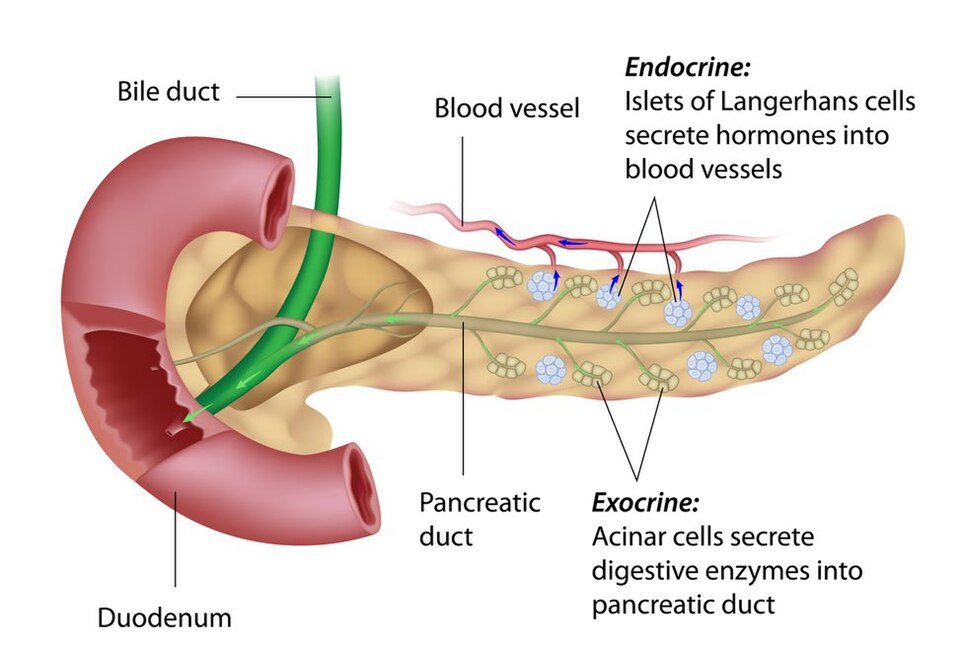
- Anatomically, it has a head, body, and tail
- The head is placed in the C-shaped curvature of the duodenum
- Tail extends leftwards to touch the spleen
- The main pancreatic duct runs along the entire length of the pancreas, which joins the bile duct to make the
hepatopancreatic duct. This duct opens in the duodenum at the ampulla of Vater, at a point located
about 4 inches from the pylorus. - It lies behind the stomach
- Produces pancreatic enzymes and insulin.
- Acid in the chyme is neutralized by pancreatic enzymes.
- It secretes enzymes which digest fats, carbohydrates, and proteins (EXOCRINE ACTION)
- The pancreas regulates blood sugar by producing insulin (ENDOCRINE ACTION)
Hormones.
Hormones are little chemical messengers that are responsible for a lot of what happens in our bodies daily. Hormones are made by several different glands in the endocrine system and travel through the bloodstream to the tissues and organs. They are released in very small amounts, but can have a great deal of effect, as hormones regulate an abundance of important processes such as growth, metabolism, reproduction, mood, and energy balance. Hormones largely serve as signals to keep the systems of the body in continuous communication to facilitate the smooth functioning of operations.
The pancreas, being a dual gland, possesses both exocrine as well as endocrine actions
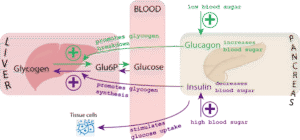
Insulin (Regulates glucose metabolism)
- Insulin is produced by the beta cells of the islets in the pancreas.
- Beta cells make up 60-70 % islet cell population.
- Insulin is a peptide hormone composed of 51 amino acids, and they arranged in two chains, A and B.
- Insulin decreases the blood glucose level in blood.
Digestive enzymes:
- Trypsin, chymotrypsin (protein digestion)
- Lipase(Fat metabolism)
- Amylase (carbohydrate metabolism)
Gall Bladder.
- It is a conical pouch, 7 to 10 cm long, up to 50 cc in volume.
- Stores bile after receiving from the liver.
- The gall bladder has the capability to concentrate the received bile up to 10 times and then release it
into the small intestine whenever required. - An excess of a fatty diet and cholesterol causes the formation of gallstones in the hepatobiliary system.
- Hepatic ducts bring bile from the liver, and the cystic duct brings bile from the gall bladder.
- The common bile duct is made up of the hepatic and cystic ducts.. joins
the pancreatic duct and forms the Hepatopancreatic duct, which opens in the duodenum at the ampulla of Vater.
Gall Bladder Has Three Parts.
The gallbladder is a flask-shaped structure located immediately under the liver and allows for the storage and release of a digestive fluid called bile it uses to assist in fat breakdown in the small intestine. While the shape and size of the gallbladder is small, the structure is relatively simple, and generally divided into three parts: the neck, body, and fundus.
- Fundus
- Body
- Neck
Release of bile is controlled by the autonomic nervous system (branches of the vagus nerve)
Function.
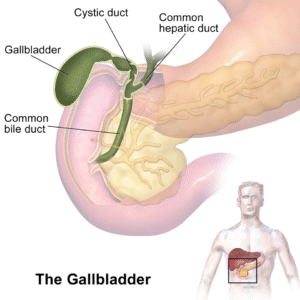
- Bile prepared in the liver is stored in the gall bladder and concentrated up to 10 times, released in the
duodenum through an opening common with the pancreatic duct at the ampulla of Vater. - Bile acts as emulcificant (converts fats into a soluble form).
- Bile eliminates cholesterol from the body.
- Gallstones are formed in cases when bile salts crystallize.