
Introduction.
A stem cell is an unspecialized cell that has the unique ability to both self-renew, producing more stem cells, and differentiate
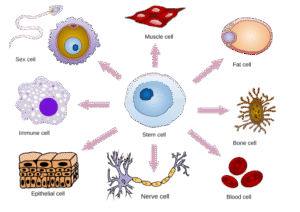
into specialized cell types such as muscle, nerve, or blood cells. These cells act as the body’s foundational or “master cells,” playing a critical role in growth, development, and tissue repair.
Stem cells can be classified based on their potency:
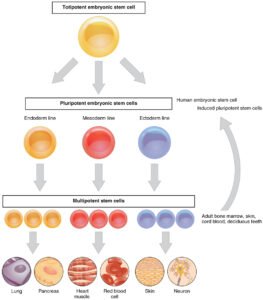
Totipotent stem cells, like the zygote, can form an entire organism, including extraembryonic tissues.
pluripotent stem cells, such as embryonic stem cells, can give rise to nearly all body cells;
Multipotent stem cells, like those in bone marrow, can form only certain types of cells within a specific lineage.
Unipotent stem cells can generate only one type of specialized cell. They are found both in early embryos and in certain adult tissues, where they maintain and repair the body.
Definition.
A stem cell is an unspecialized cell that can self-renew (make more stem cells) and differentiate (develop into specialized cell types such as nerve cells, muscle cells, or blood cells).
Origin of Stem Cells in Development.
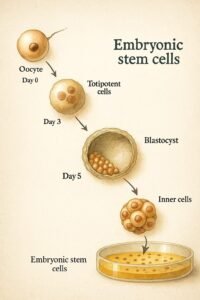
The origin of stem cells starts when fertilization occurs in humans, when sperm fertilize an egg to form a zygote. This single cell has the ability to form a whole body as well as extraembryonic tissues such as the placenta.
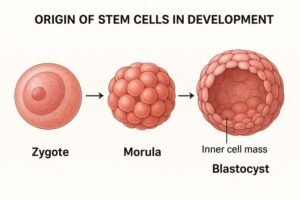
(A) Zygote Stage
- Fertilized egg = totipotent stem cell.
- It can give rise to all cell types, including those of the embryo and extraembryonic tissues (e.g., the placenta).
(B) Morula Stage (16–32 cells)
- Cells remain totipotent.
- Each blastomere has the potential to form a complete organism (the basis of identical twins).
(C) Blastocyst Stage (~5 days in humans)
- Inner Cell Mass (ICM). They form the embryo.
- Trophoblasts. They form the placenta and support tissues.
- ICM cells = pluripotent embryonic stem cells (ESCs). They can form all body tissues but not the placenta.
Types of Stem Cells.
They are classified into different types. But this classification is based on potency or ability to transform. Here are the different types of stem cells:
1. Based on Potency.
Potency is the ability of stem cells to develop into different cells in the body. The higher the potency, produce more cells are produced by stem cells.
1. Totipotent
- Found in the zygote & early morula.
- They form the complete body of the organism.
2. Pluripotent
- Found in blastocyst (inner cell mass).
- It can form any cell type in the body, but not the placenta.
3. Multipotent
- Found in later development (fetal & adult tissues).
- Restricted to certain lineages (e.g., hematopoietic stem cells → blood cells).
4. Unipotent
- Can form only one type of cell, but still has self-renewal (e.g., muscle stem cells)
2. Based on Source.
In biology, a Stem cell source is a place where stem cells are formed. Many sources provide different types of stem cells. For example, embryonic stem cells form early embryonic stage.
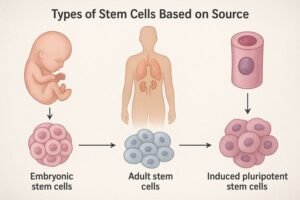
1. Embryonic Stem Cells (ESCs)
- Derived from: Inner cell mass of blastocyst (early embryo).
- Potency: Pluripotent.
- Can generate: Any body cell type.
2. Adult (Somatic) Stem Cells
- Found in: Specific tissues after birth (bone marrow, skin, intestine, brain).
- Potency: Multipotent or unipotent.
- Role: Replace and repair cells in their tissue.
3. Induced Pluripotent Stem Cells (iPSCs)
- Made by: Reprogramming adult cells (e.g., skin cells) back into a pluripotent state.
- Discovered by Shinya Yamanaka (Nobel Prize 2012).
- Advantage: Avoids ethical issues of embryonic stem cells.
4. Perinatal Stem Cells
- Found in: Umbilical cord blood, placenta, amniotic fluid.
- Potency: Multipotent.
- Medical Use: Cord blood stem cell transplants for leukemia & immune disorders.
Mechanism of Stem Cell Development.
The development of stem cells is a highly regulated process that allows them to maintain self-renewal while also generating specialized cells. This mechanism involves genetic regulation, signaling pathways, epigenetics, and the stem cell microenvironment (niche).
1. Genetic Regulation
- Special transcription factors keep stem cells in their undifferentiated state.
- Key regulators:
- Oct4, Sox2, Nanog → maintain pluripotency.
- Myc, Klf4 → control self-renewal.
- When signals change, these genes switch off, and differentiation genes turn on.
2. Signaling Pathways
Stem cells respond to chemical signals that guide whether they divide, stay stem-like, or differentiate.
- Wnt pathway → promotes self-renewal.
- Notch pathway → controls cell fate decisions.
- Hedgehog & BMP pathways → regulate tissue-specific differentiation.
- FGF & EGF signals → stimulate proliferation.
3. Epigenetic Regulation
- Development is also controlled by changes in DNA accessibility:
- DNA methylation and histone modification silence or activate genes.
- Ensures that once a cell commits to a lineage (e.g., neuron), it doesn’t revert.
- Epigenetics allows the same DNA to produce different cell types.
4. Cell Division & Asymmetry
- Stem cells undergo two types of division:
- Symmetric division → produces two identical stem cells (self-renewal).
- Asymmetric division → produces one stem cell + one specialized progenitor cell.
- This balance maintains the stem cell pool while generating differentiated cells.
5. Microenvironment (Stem Cell Niche)
- Stem cells are influenced by their surroundings, called the niche.
- The niche provides:
- Growth factors
- Extracellular matrix (ECM) signals
- Cell-to-cell communication
- Example: bone marrow niche regulates blood stem cells.
6. Differentiation into Lineages
- Once activated, stem cells follow lineage-specific pathways:
- Ectodermal lineage → neurons, skin cells.
- Mesodermal lineage → muscle, bone, blood.
- Endodermal lineage → liver, pancreas, lungs.
- Controlled by combinations of transcription factors + external signals.
Developmental Role of Stem Cells
Stem cells play an important role in human development because they form all tissues and organs. Development continues, and stem cells form three layers: ectoderm, endoderm, and mesoderm. They develop specialized structures like skin, muscles, nerves, and internal organs. After birth, stem cells ensure the continuous repair, regeneration, and replacement the damaged cells throughout life. Without stem cells body does not grow.
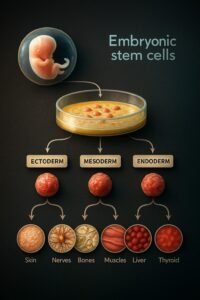
Embryonic Development
- ESCs form all tissues and organs through differentiation.
- Example: ectoderm → neurons, mesoderm → heart, endoderm → pancreas.
Fetal Development
- Multipotent stem cells develop (e.g., blood stem cells in the liver → later in bone marrow).
Adult Organism
- Stem cells persist in some tissues (bone marrow, skin, intestine).
- They replace worn-out cells and repair minor injuries.


