Bacteria are microscopic, single-celled prokaryotic organisms that exist almost everywhere on Earth in soil, water, air, inside living organisms, and even in extreme environments. They are among the earliest life forms and play essential roles in ecosystems, industries, and health.
Bacteria can reproduce quickly because they reproduce by binary fission and can adapt, living in many environments. Bacteria are studying more than any other organism in biology due to their impact in medicine, agriculture and industry.
Types of Bacteria.
Bacteria are classified based on shape and structure into 4 different types:
- Coccus (spherical)
- Bacillus (rod-shaped)
- Spirillum/Spirilla (spiral)
- Vibrio (comma-shaped)
Coccus (spherical).
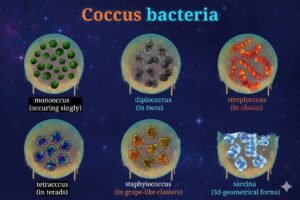
Cocci are spherical or oval-shaped bacteria. The term comes from the Greek word kokkos, meaning “berry.” They can occur as single cells or in characteristic arrangements, depending on how they divide and stick together.Cocci reproduce by binary fission, usually by dividing in one or more planes, resulting in the various arrangements like pairs, chains, clusters, or cubes, respectively. Cocci generally may either be Gram-positive or Gram-negative; this distinction indicates that the structures of the cell walls of cocci vary, which is significant when subjected to a gram stain.
General Characteristics:
- Shape: Round, oval, or slightly elongated.
- Size: Typically 0.5–1.0 µm in diameter.
- Gram reaction: Can be Gram-positive (e.g., Staphylococcus, Streptococcus) or Gram-negative (e.g., Neisseria).
- Reproduction: Divide by binary fission in one or more planes.
Arrangements of Cocci.
Depending on their division planes:
- Monococcus – single cocci (e.g., Micrococcus).
- Diplococci – pairs of cocci (e.g., Neisseria gonorrhoeae).
- Streptococci – chains of cocci (e.g., Streptococcus pyogenes).
- Staphylococci – grape-like clusters (e.g., Staphylococcus aureus).
- Tetrads – groups of four (e.g., Micrococcus).
- Sarcinae – cube-like packets of 8 or more (e.g., Sarcina).
Bacillus (rod-shaped).
Bacillus bacteria are rod-shaped prokaryotic microorganisms. The term bacillus (with its plural being bacilli) is defined as rod-shaped bacteria that are elongated and in a cylindrical shape. This is one of the most frequently found shapes among bacteria. They belong to the group of bacteria characterized by their cylindrical or elongated shape. The term bacillus can refer to rod-shaped bacteria in general, or to the genus Bacillus, which includes both harmless and pathogenic species. General Characteristics:
- Shape: Rod-like (straight or slightly curved).
- Size: 0.5–1 µm wide, 1–10 µm long.
- Gram reaction: Can be Gram-positive (e.g., Bacillus anthracis) or Gram-negative (e.g., Salmonella).
- Motility: Many are motile with flagella.
- Spores: Some produce resistant endospores.
- Reproduction: Binary fission
Arrangements of Bacillus.
Depending on how they divide and remain attached:
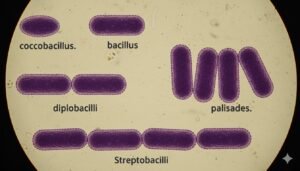
- Single bacillus – individual rods (e.g., E. coli).
- Diplobacilli – paired rods, end-to-end (e.g., Klebsiella pneumoniae).
- Streptobacilli – chains of rods (e.g., Streptobacillus moniliformis).
- Coccobacilli – very short rods, almost spherical (e.g., Haemophilus influenzae).
- Palisades – rods arranged side by side like a fence or at angles (e.g., Corynebacterium diphtheriae).
Spirillum/Spirilla (spiral).
Spirillum bacteria are spiral or helical-shaped prokaryotic microorganisms. The word spirillum comes from Latin, meaning “little coil.” They are rigid, corkscrew-like bacteria that move with the help of flagella.
General Characteristics:
- Shape: Spiral, corkscrew, or helical.
- Size: Usually 1.5–5 µm wide and up to 60 µm long.
- Cell wall: Mostly Gram-negative.
- Motility: Possess polar flagella (on both ends) for movement.
- Reproduction: Asexual by binary fission.
- Examples:
- Spirillum volutans – found in stagnant water, one of the largest bacteria.
- Spirillum minus – associated with rat-bite fever.
Arrangements of Spirillum.
Spirilla show different coiled arrangements:
- Single spirillum – one spiral-shaped bacterium (e.g., Spirillum volutans).
- Diplospirilla – two spirilla attached together.
- Chains of spirilla – sometimes form short chains, though less common than in bacilli.
- Spirochetes (related group) – thin, flexible spiral bacteria (e.g., Treponema pallidum, cause of syphilis).
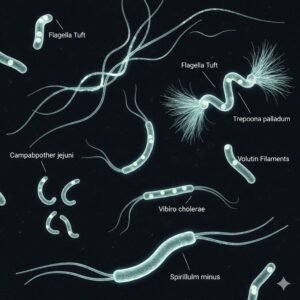
Vibrio (comma-shaped).
Vibrio bacteria are comma-shaped (curved rod) prokaryotic microorganisms. The name Vibrio comes from Latin, meaning “to vibrate,” because under a microscope, they often appear to vibrate due to their motility. Many species of Vibrio are anaerobic means they can survive with or without oxygen. But some are harmful and naturally occur in the ecosystem. They cause many diseases in humans and other animals.
General Features
- Shape: Curved rod, comma-shaped.
- Size: Usually 1.5–3 µm long and 0.5–0.8 µm wide.
- Gram reaction: Gram-negative.
- Reproduction: Binary fission (asexual).
- Habitat: Mostly aquatic (marine and freshwater).

Examples:
- Vibrio cholerae → causes cholera.
- Vibrio parahaemolyticus → causes food poisoning from seafood.
- Vibrio vulnificus → causes wound infections and septicemia.
Arrangements of Vibrio.
Unlike cocci or bacilli, vibrios usually occur in:
- Single Vibrio – single, comma-shaped cell (most common form).
- Diplovibrios – two vibrios joined together (looks like an “S” shape).
- Chains of vibrios – sometimes form short chains after repeated division.