Introduction.
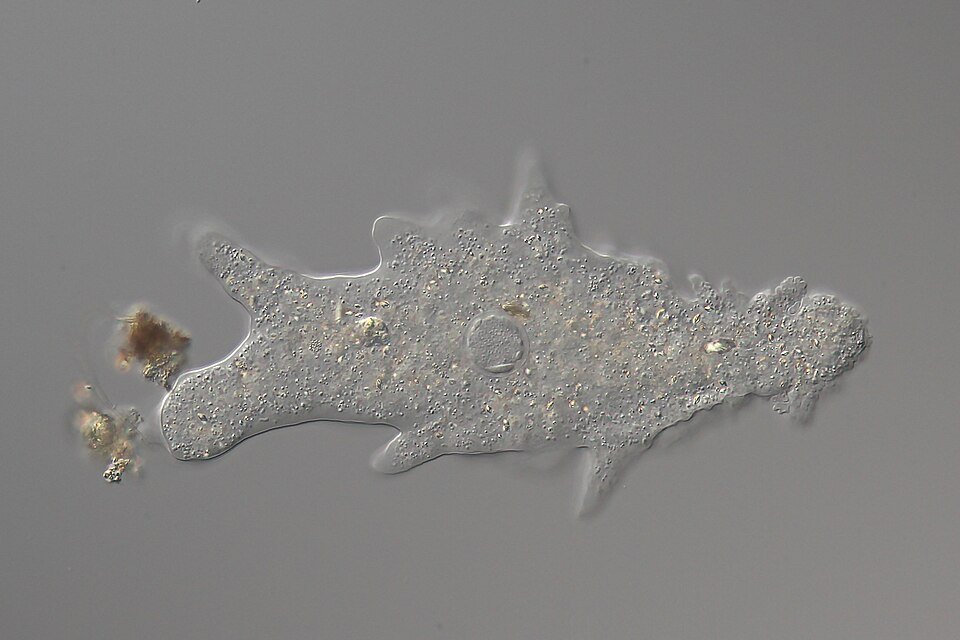
An amoeba is a microscopic, single-celled organism that belongs to the kingdom Protista. It is well known for its constantly changing shape due to the presence of pseudopodia, which are temporary extensions of its cytoplasm used for movement and capturing food. Amoeba lives mostly in freshwater, moist soil, and decaying vegetation, while some species are parasitic and can cause diseases in humans. It has a simple body structure with a flexible cell membrane, cytoplasm, nucleus, contractile vacuole, and food vacuoles. Amoeba feeds on microorganisms such as bacteria and algae by the process of phagocytosis and reproduces asexually through binary fission. Because of its simplicity and unique mode of life, the Amoeba is often studied as a model organism in biology.
Structure of Amoeba.
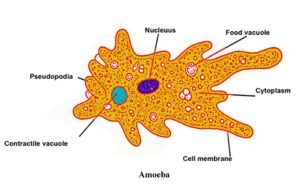
- Cell Membrane – Amoeba has a thin and flexible covering, allows for the exchange process.
- Cytoplasm – Amoeba has two different regions, outer ectoplasm that appears clear with a gel-like appearance, and inner endoplasm that appears granular and an intermediate liquid.
- Nucleus – Amoeba controls cell functions, provides genetic material.
- Pseudopodia (“false feet”) –Amoeba’s temporary projections of the cytoplasm used for movement and capturing food.
- Contractile Vacuole –Amoeba regulates water balance (osmoregulation).
- Food Vacuole – An Amoeba forms after engulfing food particles, where digestion occurs.
Characteristics
- Amoeba are Microscopic and shapeless (constantly changing form) organisms.
- An amoeba moves by amoeboid movement using pseudopodia.
- They feed by phagocytosis (engulfing food like bacteria, algae, and small particles).
- Amoeba reproduces asexually by binary fission.
- Unicellular – Amoeba represents a single-cell organism; it can perform all necessary life functions.
- Eukaryotic – It has a discrete nucleus with a nuclear membrane.
- Irregular shape – Amoeba does not have a definitive body. It continually changes shape, due to extensions called pseudopodia.
- Nutrition – Amoeba are heterotrophic, meaning they consume food. Amoeba engulf their food material (i.e., algae and bacteria) through a process called phagocytosis and will digest the engorged food in small vesicles called food vacuoles.
- Reproduction – Amoeba will primarily reproduce asexually through binary fission. In binary fission, the nucleus is divided first before the cytoplasm is cored
Types of Amoeba.
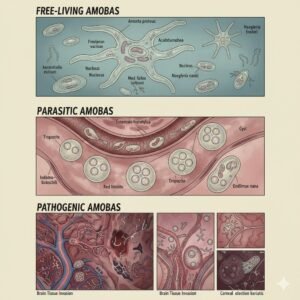
1. Free-living Amoebas
- Some amoeba found in freshwater, soil, and moist environments.
- Amoeba usually harmless to humans.
- Example: Amoeba proteus – a common freshwater amoeba often studied in labs.
2. Parasitic Amoebas
- Amoeba Live inside the bodies of humans or animals.
- It can cause diseases.
- Examples:
- Entamoeba histolytica – causes amoebic dysentery (amoebiasis) in humans.
- Entamoeba gingivalis – found in the human mouth; associated with gum disease.
- Entamoeba coli – lives in the human intestine but is usually harmless (non-pathogenic).
3. Opportunistic Pathogenic Amoebas
- Normally amoeba free-living, but can infect humans under certain conditions.
- Examples:
- Naegleria fowleri – known as the “brain-eating amoeba” causes a rare but deadly brain infection.
- Acanthamoeba species can infect the eye (causing keratitis) and the brain.
Importance.
- Ecological role: Helps recycle nutrients by feeding on microorganisms.
- Medical importance: Some species are pathogenic (cause disease).
- Research: Model organism for studying cell movement and physiology.
1. Ecological Importance
- Nutrient recycling: Amoebas feed on bacteria, algae, and other microorganisms, helping control their population and maintain ecological balance.
- Food chain role: They serve as food for larger microorganisms and small aquatic animals, contributing to the food web.
2. Biological & Scientific Importance
- Model organism: Amoeba proteus is widely studied in biology to understand cell structure, movement, osmoregulation, and reproduction.
- Research in cell biology: Amoebas demonstrate processes like phagocytosis (cell eating) and cytoplasmic streaming, which are important for studying immune cell functions in higher organisms.
3. Medical Importance
- Some species are pathogenic:
- Entamoeba histolytica → causes amoebiasis (amoebic dysentery) in humans.
- Naegleria fowleri → causes rare but fatal brain infections.
- Acanthamoeba → causes eye infections and skin/brain diseases in immunocompromised people.
4. Environmental Indicator
- Amoebas can indicate the quality of water and environmental conditions, since some species thrive in polluted areas.
Reproduction of Amoeba.
Amoeba reproduce in two ways: Sexually and Asexually.
Asexually reproduce ( Binary Fission)
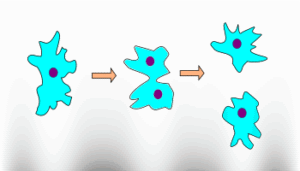
On the whole, the method of reproduction used by the Amoeba is binary fission. In this method the nucleus divides first (mitosis), and then the cytoplasm divides in half creating two Amoebae. The two daughter cells are identical to the parent and both will usually grow to full size. Binary fission usually occurs when conditions are favorable, for example when there is food and water is available.
Multiple Fission
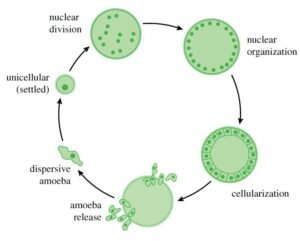
Under unfavorable conditions (as in, dry or no food), amoeba undergoes a protective covering around itself, which is called a cyst. Inside the cyst, the nucleus, within the protective covering, divides many times to form several daughter nuclei with a small amount of cytoplasm around each nucleus. When favorable conditions return, then the cyst will burst and young amoeba will be released.
Sexual Reproduction (Rare)
In some species some sexual reproduction can occur. It generally consists of the two gametes (haploid nuclei) fusing to form a diploid zygote nucleus that later develops into a new Amoeba. Thus, it is rare compared to the number of asexual means.