
Introduction.
Parkinson’s disease (PD) is a progressive neurodegenerative disorder that affects movement control. It happens when nerve cells in the brain, especially in the substantia nigra (part of the midbrain), become damaged or die. These cells normally produce dopamine, a chemical messenger that helps regulate smooth and coordinated muscle movements. When dopamine levels drop, abnormal brain activity occurs, leading to movement difficulties and other symptoms.
Causes.
The exact cause of Parkinson’s is unknown. It may have both genetic and environmental components.
- Low levels of dopamine and norepinephrine, a substance that regulates dopamine, have been linked with parkinson’s.
- Abnormal proteins called Lewy bodies have also been found in the brains of people with parkinson’s.
- Scientists don’t know what role, if any, Lewy bodies play in the development of parkinson’s.
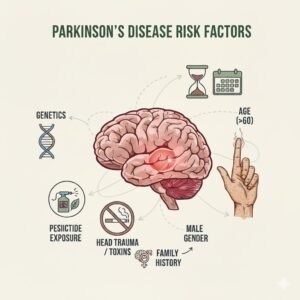
- Environmental triggers (exposure to pesticides, toxins, heavy metals)
- Age (common after age 60)
- Gender (slightly more common in men)
- Family history
Risk Factors.
Sex.
- Men are one and a half times more likely to get Parkinson’s than women.
Race.
- Whites are more likely to get parkinson’s than African Americans or Asians.
Age.
- Age is the strongest risk factor.
- Parkinson’s usually appears between the ages of 50 and 60. It only occurs before the age of 40 in 5-10 percent of cases.
Family history.
- People who have a close family member with Parkinson’s disease are more likely to develop Parkinson’s disease too.
Toxin.
- Exposure to certain toxins may increase the risk of Parkinson’s disease.
Head Injury.
- People who experience head injuries may be more likely to develop Parkinson’s disease
Gentics.
- Genetic mutation is also linked to parkinson disease.
Environmental Exposure.
- Long-term use of pesticides and heavy metals can increase the risk of these diseases.
- Living in a toxic environment, like a rural area, can also increase the risk of these diseases.
Head Injuries.
- A higher probability of developing Parkinson’s later in life may occur with recurrent head trauma, or repeated concussions.
Occupational Hazards.
- Exposure to chemicals or industrial toxins in toxic environments (like manganese or carbon monoxide) also seem to increase risk.
Lifestyle Factors.
- An inadequate diet and being sedentary may marginally raise risk.
- Interestingly, smoking and consuming caffeine seem to reduce risk, not recommended as protective factors because of the health risks associated with both behaviors.
Symptoms.
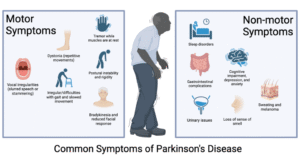
Parkinson’s symptoms develop gradually and worsen over time. They are usually divided into motor and non-motor symptoms.
1. Motor Symptoms:
- Tremor (shaking, often starting in the hands or fingers)
- Bradykinesia (slowness of movement)
- Muscle rigidity (stiffness in arms, legs, or trunk)
- Postural instability (balance problems, frequent falls)
- Small handwriting (micrographia)
- Shuffling gait (short steps, reduced arm swing)
2. Non-Motor Symptoms:
- Sleep disturbances
- Depression and anxiety
- Memory problems and dementia (in later stages)
- Constipation
- Loss of smell (early sign)
- Speech changes (soft, slurred voice).
Complications.
- Thinking difficulties
- Depression and emotional changes
- Swelling problems
- Chewing and eating problems
- Sleep problems
- Bladder problem
- Constipation
- Smell dysfunction
- Blood pressure problem: hypotension
- Sexual dysfunction
Diagnosis.
There is no single test for Parkinson’s. Diagnosis is based on:
- Medical history
- Neurological examination
- Ruling out other conditions
- Brain imaging (MRI, PET, or DaTscan) may support diagnosis but not confirm it.
Treatment.
- Carbidopa/levodopa
- Carbidopa/levodopa infusion.
- Dopamine agonists, e.g, pramipexole, ropinirole, and rotigotine
- MAO B Inhibitors, e.g, selegiline, rasagiline
- Catechol O-methyltransferase (COMT) inhibitors. Entacapone
- Anticholinergicsbenztropine
- Amantadine
Conclusion.
Parkinson’s disease is a chronic disease that affects movement and body functions caused by damage to dopamine-producing neurons in the brain. There is currently no cure. But in the modern era, many treatments like medication, therapies, and surgical techniques have been discovered that can help in treatment. Early treatment consiste of medical care and changing lifestyle, which helps to reduce parkinson disease. But modern research gives hope for the future; one day, we will get a technique or treatment and reverse the effects of parkinson disease.


