Introduction.
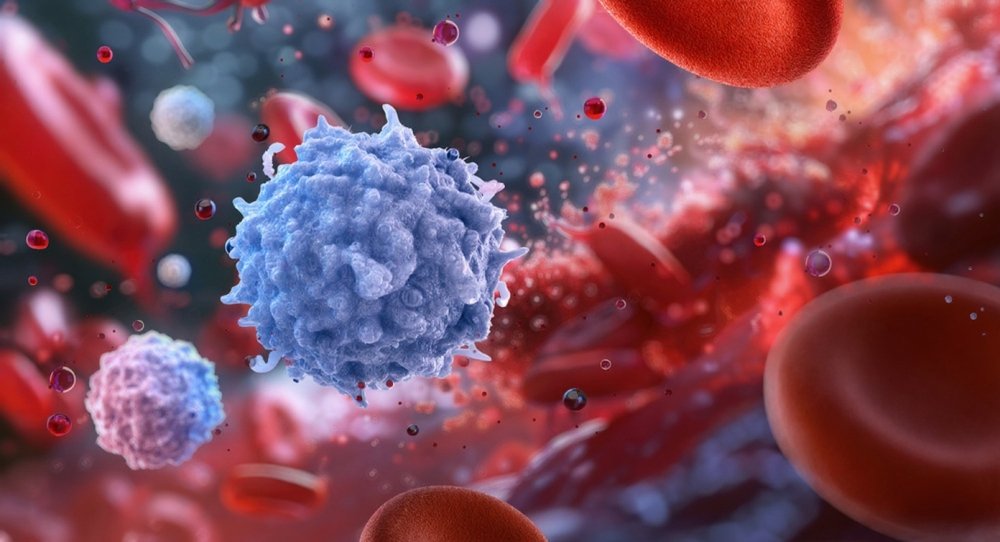
Lymphocytes are a type of white blood cell (WBC) that play a central role in the body’s immune system. They are part of the adaptive immunity, meaning they can recognize and remember specific pathogens (like bacteria, viruses, or abnormal cells) and respond more effectively upon future exposure.
Types of Lymphocytes:
- T Cell
- B Cell
- NK Cell (Natural Killer)
1. T Cell.
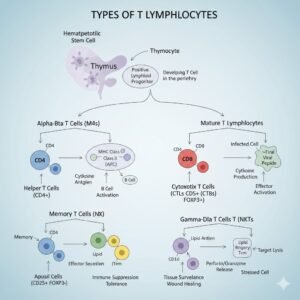
Approximately 80 percent of circulating lymphocytes are classified as T cells ( T lymphocytes ). T cells (or T lymphocytes) are a specialized group of white blood cells that play a central role in the body’s adaptive immune system. They are named after the thymus, the organ where they mature. Unlike B cells, which produce antibodies, T cells primarily work by directly attacking infected or abnormal cells or by regulating other immune cells. There are many different types of T cells, but we will focus on four major categories.
Cytotoxic T cells.
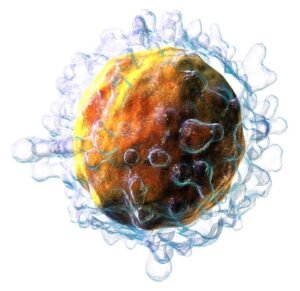
Cytotoxic T cells—also known as CD8⁺ T cells or killer T cells—are a category of T lymphocytes that are instrumental in protecting the body from cells infected with viruses, tumor cells, and donated tissue cells. They are the adaptive immune system’s “attack force.“
- A cytotoxic T cell will attack a foreign cell, or body cell infected with a virus.
- The attack will often be done by using direct contact with the target cell.
- These lymphocytes are the main cells involved in the production of cell-mediated immunity ( cellular immunity ).
Helper T cells.
Helper T cells, also called CD4⁺ T cells, are a type of lymphocyte that plays a coordinating and regulating role in the immune system. Unlike cytotoxic T cells, they do not directly kill pathogens. Instead, they act as “managers” or “directors” that activate and guide other immune cells to mount a strong and effective defense.
- Helper T cells stimulate the response of both T cells and B cells.
- Helper T cells are absolutely vital because they must activate B cells before the B cells can produce antibodies.
Regulatory T cells.
Regulatory T cells (Tregs) are a special subtype of T lymphocytes that function as the “peacekeepers” of the immune system. Their main role is to suppress excessive or misdirected immune responses, maintaining immune tolerance and preventing damage to the body’s own tissues (autoimmunity).
- Regulatory T cells are a subset of T cells that modulate the immune response.
- They an interplay between regulatory T cells and Helper T cells.
- Botha helps establish and control the sensitivity of the immune response.
Memory T cells.
Memory T cells are a special subset of T lymphocytes that provide long-term immunity after an infection or vaccination. They “remember” the specific pathogen that activated them, so if the same pathogen enters the body again, they respond faster and stronger than during the first encounter.
- Provide the body with long-lasting protection after infections or vaccinations.
- Essential for secondary immune responses, where the pathogen is eliminated more effectively than during the first encounter.
- Deficiency in memory T cells can lead to repeated infections.
- Memory T cells respond to an antigen they have already encountered by cloning more lymphocytes to ward off the invader.
AI-generated illustration created with Google Gemini – © GetScienceMe
2. B Cell.
B cells are a type of lymphocyte (white blood cell) that play a central role in the humoral immune response by producing antibodies. They are named after the bursa of Fabricius (an organ in birds where they were first discovered), but in humans and mammals, they mature in the bone marrow.
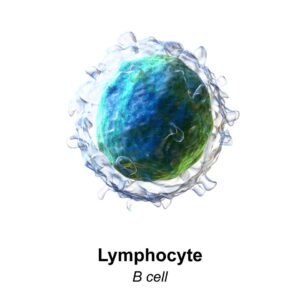
Types of B Cells
-
Naïve B Cells
- Mature but have not yet encountered an antigen.
-
Plasma Cells
- Activated B cells that produce and secrete antibodies.
-
Memory B Cells
- Long-lived cells that “remember” antigens and respond rapidly upon re-exposure.
-
Regulatory B Cells (Bregs)
- Help control immune responses by secreting anti-inflammatory cytokines (like IL-10).
3. NK Cell (Natural Killer).
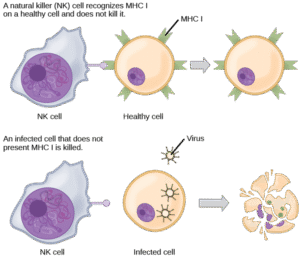
Natural Killer (NK) cells are a type of lymphocyte that belongs to the innate immune system. Unlike B and T cells, they do not require prior exposure to a pathogen to act. Instead, they can directly kill virus-infected cells, tumor cells, and abnormal body cells without prior sensitization.
- Missing-self” recognition: If a cell lacks normal MHC I molecules, NK cells recognize it as abnormal and kill it.
- Balance of signals: NK cells use both activating receptors and inhibitory receptors.
- Healthy cells with normal MHC I → send inhibitory signals → spared.
- Abnormal cells lacking MHC I → no inhibition → targeted for destruction.