Introduction.
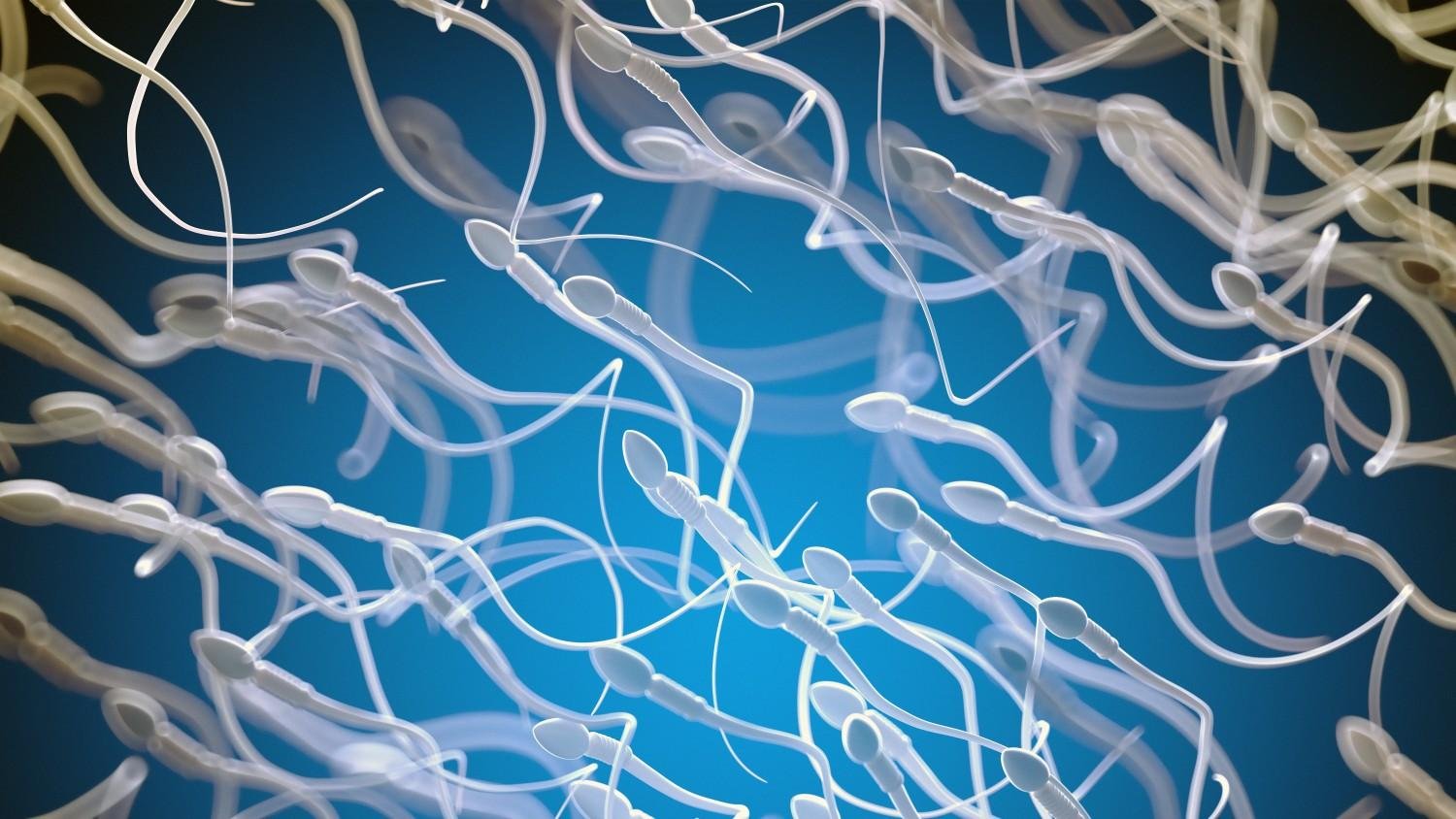
The word sperm comes from the Greek word “sperma,” meaning seed. Its role in reproduction. A sperm cell is the male gamete. Sperm cells are also called spermatozoa. It is the microscopic structure of the male reproductive part that carries the father’s genetic material. It’s responsible for fertilizing the female egg (ovum). It is the germ line cell that divides by the meiosis process. It is the haploid cell that contains 23 chromosomes. They have a specialized structure for mortality. They have three main parts:
Main Parts of the Sperm:
The sperm cell consiste of four parts: the Head, Neck, Midpiece, and tail. The head consiste of a nucleus with genetic information, the cup-shaped structure called the Acrosome, which releases enzymes to penetrate the egg’s outer layer. The neck simply connects the head to the midpiece. The midpiece contains many mitochondria that provide power for movement, and the tail (or flagellum) provides movement through whip-like intervals for propulsion. This unique structure allows the sperm cell to have both power and direction ultimately allowing them to reach and fertilize the egg.
- Head
- Neck
- Middle Piece
- Tail
1. Head.
The head of sperm is a special structure that plays an important role in fertilization. They are the flattened shape that contains two key components: the nucleus and the acrosome. The nucleus occupies most of the headspace. The nucleus contains 23 haploid chromosomes of the father’s genetic material. They ensure that when sperm enter the egg, 46 diploid chromosomes are
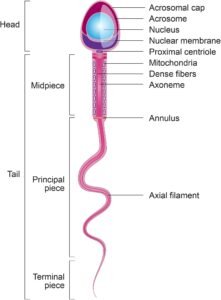
present. The outer covering of the nucleus is the Acrosome, a cup-shaped structure that is derived from the Golgi Apparatus. The acrosome contains many enzymes. These enzymes break the outer layer of the egg.
- Acrosome: A cup-like structure containing enzymes that help penetrate the egg.
- Nucleus: Contains paternal DNA ( 23 chromosomes).
- Nuclear Vacuoles: Small pockets that may influence DNA packaging.
- Cell Membrane: Outer covering that protects and maintains cell integrity.
- Post Acrosomal Sheath: Assists in binding with the egg.
2. Connecting piece ( Neck ).
The neck is the short piece that connects the head to the mid-piece. They are the smallest part of the sperm. They play an important role in the sperm. The neck has centrioles that are used to assist in the organization of microtubules and the creation of the sperm tail. One of the centrioles, the proximal centriole, will later contribute to the first mitotic spindle of the zygote after fertilization, guaranteeing the correct division of the newly formed cell. The distal centriole generates the axoneme of the flagellum, which assists in the movement of the sperm. The function of the neck of the sperm is to act like a bridge that transmits energy produced in the midpiece directly to the tail for the movement of the sperm. Thus, the neck of the sperm is extremely small and very important academically for both structure and function toward reproduction.
- There is a short segment that connects the head to the tail and ensures stability.
- They contain the centrioles, which are important for the development of the mitotic spindle for zygote fertilization.
- Centriole initiates tail formation that contributes to embryo development.
3. Middle Piece.
The midpiece of the sperm is often called the powerhouse because it provides energy for motility. Its arrangement is a cylindrical shape after the neck and before the tail. The midpiece also contains the continuation of the axial filament to transmit the energy produced to the tail to facilitate coordinated movement. Any defect in the midpiece, such as structural defects or mitochondrial dysfunction, will impair motility, resulting in infertility. The midpiece is vital as the energy center directing the sperm toward successful fertilization.
- They are the thickest part of the tail.
- Redundant Nuclear Envelope: Remains of the nuclear covering support structure.
- Mitochondria: Provide energy ( ATP) for motility.
- Axonome: Structural core that drives movement.
4. Tail.
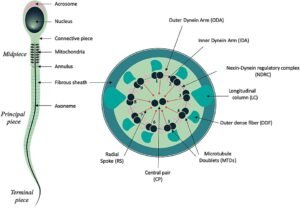
The flagellum, or tail of the sperm, is the longest region of the cell and is primarily responsible for motility. The tail derives from
the midpiece and has an internal structure called the axoneme, which consists of microtubules in what is a typical “9 + 2” arrangement seen in cilia and flagella. The tail acts like a whip or a propeller, push-kicking or whip-like motions to push the sperm from the female reproductive tract. The motility provided by the tail is the most important component needed to reach the egg and penetrate it for fertilization. The energy for this motility is provided by the midpieces’ mitochondria; the energy provided by the mitochondria is translated to the anchoring holding of the axoneme, bending and flexing the tail. Any abnormalities to the tail that impact normal structure, like abnormalities to the axoneme or improper flexibility, will greatly affect sperm motility and sperm viability and lead to male infertility. The tail, thus, provides the sperm with active motion toward successful fertilization.
- They are the longest part of the sperm.
- They are composed of an axoneme fiber (9+2 microtubule arrangement).
- Axial Filament: Propels the sperm forward with whip-like motion.
- Terminal Disc: End junction supporting tail structure.
- End Piece: Tapering tip aids smooth movement.
- Cell Membrane: Covers the entire tail, ensuring flexibilty.
Function of Sperm.
a. Fertilization
- The primary function of sperm is to fertilize the female egg by delivering male genetic material.
- Sperm reaches the egg in the fallopian tube and undergoes the acrosome reaction to penetrate the zona pellucida of the egg.
b. Genetic Transmission
- Every sperm contains 23 chromosomes (either X or Y), carries half of the genetic material to the zygote.
- X sperm → female child (XX)
- Y sperm → male child (XY)
c. Motility and Navigation
- Sperm are motile and use their tail to swim through the female reproductive tract.
- Guided by chemotaxis and thermotaxis toward the egg.