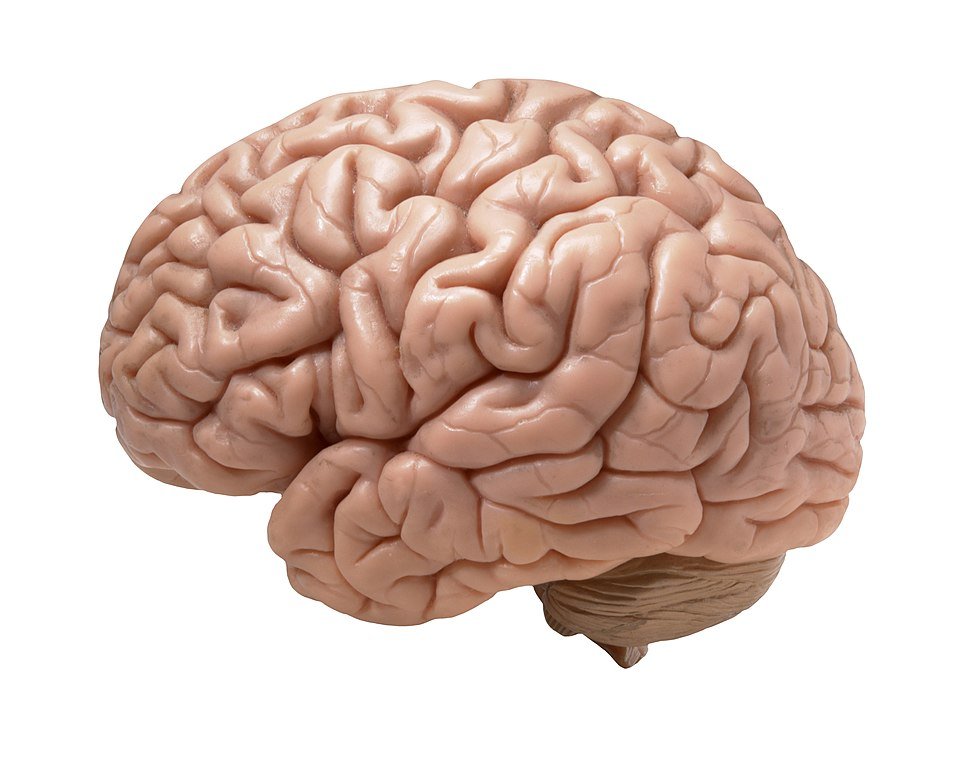
The brain is the main organ of the central nervous system, which controls all physical activities like memory, thought, emotion, touch, vision, breathing, temperature, motor skills, etc. The skull bone protects this; the meninges cover the brain. and also CSF ( cerebrospinal fluid). The brain is divided into three parts: forebrain, midbrain, and hindbrain. The weight is about 1.3 kilograms.
Major Division of the Brain.
They are divided into three parts.
- Forebrain (Prosencephalon).
- Midbrain (Mesencephalon).
- Hindebrain (Rhombencephalon).
1. Forebrain (prosencephalon).
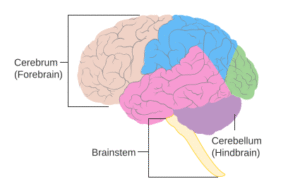
The forebrain is the largest part of the brain. It is the most highly developed part of the Human brain. They are responsible for many functions like thinking, reasoning, emotion, and voluntary response. They are divided into the Cerebrum, Thalamus, and Hypothalamus.
Cerebrum.
The cerebrum is the largest part of the forebrain. It controls skeletal muscles, thinking, Intelligence, and emotion. They are divided into two parts. Right Hemisphere and Left Hemisphere. The front part of the hemisphere is called the Olfactory Bulbs. They receive nerve impulses from the olfactory nerve and create sensation for the smell. The cerebral cortex is the upper layer of the cerebral hemisphere. They consist of gray matter. The gray matter consists of cell bodies and non-myelinated axons. White matter is present beneath this layer. White matter consists of myelinated axons. The cerebral cortex is large and folded. It is divided into four lobes (plus a hidden lobe).
Lobes:
- Frontal Lobe
- Parietal Lobe
- Occipital Lobe
- Temporal Lobe
- Insula ( Hidden lobe)
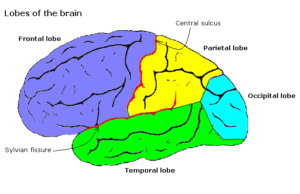
1. Frontal Lobe:
- They are located at the front part of the brain and behind the forehead.
- They control voluntary motor movement.
- They are responsible for planning, problem-solving, reasoning, and decision-making.
- They involve speech production.
- They regulate the social behaviour, emotion, personality, etc.
2. Parietal Lobe:
- They are located behind the frontal lobe or the upper middle part of the brain.
- They process sensory information such as touch, heat, pain, pressure, etc.
- They help with the spatial orientation.
- They give information through different senses.
3. Occipital Lobe:
- They are located at the back of the brain.
- They are responsible for vision.
- They process visual information such a color, light, shape, and motion.
- They help in interpreting and recognizing objects and faces.
4. Temporal Lobe:
- They are located near the ears or the side of the brain.
- They are responsible for hearing and auditory processing.
- They are involved in language comprehension.
- It plays a major role in emotion and learning.
- They store memory (Hippocampus).
Insula ( Hidden lobe).
- They are located between the temporal and frontal lobes (deep inside the lateral sulcus).
- They involve taste, pain, emotion, and consciousness.
- They play a major role in self-awareness.
Thalamus.
They are located just below the cerebrum. They consist of the two halves. They are the relay center between the brain and the spinal cord. They receive and modify sensory impulses before they travel to the cerebrum. They divide into three areas: anterior, medial, and lateral parts. They are also involved in pain and consciousness (awake and asleep). They also play a role in sleep initiation, stabilization, and termination. The other functions are attention, memory, and sleep
Hypothalamus.
They are present above the midbrain and below the thalamus. The size is almost an almond. The most important function of the hypothalamus is to link the endocrine system and the nervous system. They control the release of the pituitary gland hormones like TRH, CRH, GnRH, GHRH, Somatostatin, and dopamine, but they also produce the posterior pituitary hormones like ADH and oxytocin. They control the sympathetic and parasympathetic activity in the body. They regulate the heart rate, blood pressure, digestion, and breathing patterns. They also control feeling, pain, pleasure, and sorrow.
2. Midbrain (Mesencephalon).
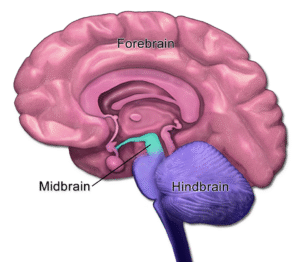
They are present between the forebrain and hindbrain, and are just located upper part of the brain stem.it divided into the dorsal part (tectum) and ventral part (tegmentum) region. Both perform different functions. Tectum (dorsal part) performs tracking moving objects, pupil reflex, and also responds to loud sounds. while the Tegmentum (ventral part) plays a role in movement, alertness, consciousness, and motor coordination. The main function of the midbrain initiates and regulates movement, like eye movement, pupil dilation, and eye muscles etc. They also perform other functions sound information, wakefulness, and the sleep cycle.
3. Hindebrain (Rhombencephalon).
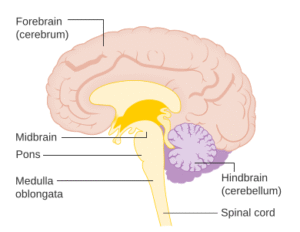
There is the posterior part of the brain. They are located behind the midbrain. They connect the brain to the spinal cord. They control many involuntary functions such as breathing, heartbeat, and body balance. They consiste of the three parts.
- Medulla Oblongata
- Pons
- Cerebellum
Medulla Oblongata.
They are located at the lowest part of the brain stem and continue to the spinal cord. They control many functions, like involuntary functions, e.g., heart rate, breathing, blood pressure, vomiting, and sneezing. and contains the respiratory and cardiovascular center. They relay sensory information and motor signals between between spinal cord and the brain. and also responsible for alertness and reflexes.
Pons.
They are located above the medulla and below the midbrain. They perform many functions; they act as a bridge between the cerebrum, cerebellum, and medulla. They regulate breathing rhythm. They are also involved in sleep and facial expression.
Cerebellum.
They are located behind the medulla and pons. They are divided into three parts:
- Vestibulocerebellum
- Spinocerebellum
- Cerebrocerebellum
They perform functions in motor activity and maintain balance, posture, and muscle tone. and play a role in motor learning. eg. riding a bike, playing cricket, and dancing.